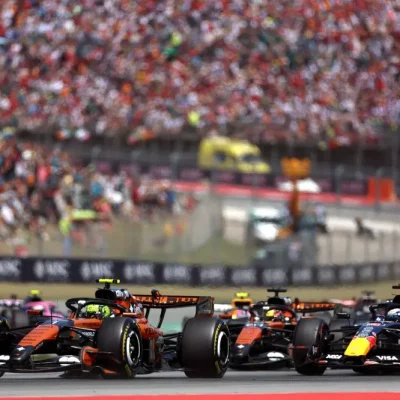



Red Bull’s drivers are continuing to wrestle with one of the most persistent weaknesses of their Formula 1 season: race starts. While flashes of strong launches have occasionally appeared, both Max Verstappen and Isack Hadjar have repeatedly struggled to consistently nail the opening seconds off the line, often slipping backwards before the field even reaches Turn 1.
By contrast, several rivals that faced similar difficulties earlier in the year appear to have turned a corner. Mercedes-AMG Petronas Formula One Team stands out in particular, having made clear progress in this area. Rookie Kimi Antonelli was initially among the most inconsistent starters on the grid, frequently losing ground at lights out during the opening rounds. However, in recent races, Mercedes appears to have stabilized its launch procedure, with Antonelli now delivering far more controlled and repeatable starts over the past three Grand Prix weekends.
At Red Bull Racing, though, the issue remains unresolved and increasingly costly. The root problem appears to lie in a start procedure that drivers describe as overly sensitive—demanding a level of precision that leaves little margin for real-world variability.
That fragility was once again exposed in Barcelona, where Isack Hadjar endured a particularly damaging getaway. After qualifying sixth and lining up immediately behind his teammate, the French driver plunged to 14th on the opening run to Turn 1, losing eight positions in a matter of seconds.
Despite that setback, Hadjar recovered well to finish sixth, but the damage to his race had already been done. Reflecting on the incident, he did not hide his frustration, describing the start as a “nightmare” and urging the team to act quickly, arguing that competitors have already simplified their systems while Red Bull’s remains overly demanding.
Speaking to F1 TV, he was blunt about the recurring issue:
“We just need to work on our starts, because it’s just yeah it’s not possible to keep going like that. Every race weekend it’s the same story. Today was a nightmare, but the whole weekend I was struggling. It’s really the point we need to work on because everyone’s made progress, but I went backwards again. So, yeah, procedure is too difficult. Window is too small.”
He expanded further in the media pen, emphasizing how narrow the operational window feels from the cockpit and how easily things can go wrong under race pressure.
“I don’t know man. It’s just the whole weekend has been like this for me. I think out of the six practice starts we had the whole weekend, that one was the worst—and it had to happen on the grid. I stalled twice, which I never did the whole season. So yeah, we need to fix these issues because the procedure is way too complicated. I’m not a computer, I’m not a machine, I can’t be 0.0001% precise. It’s not working.”
Behind the scenes, Red Bull team principal Laurent Mekies has acknowledged the concern, linking the issue to the complexity of integrating and optimizing its current power unit and chassis systems. He suggested that the difficulty lies in finding the ideal operating window for launches, particularly in a season marked by ongoing development on the power unit side.
“We didn’t get a good start. We have had weak starts so far this season. It’s part of year one as power unit manufacturers. We learned there is a lot of things we need to improve and to work out between chassis side and PU side.”
However, Mekies stopped short of confirming when a definitive fix might arrive, framing the situation instead as an ongoing development challenge rather than an immediate solution.
For now, the pattern is clear: while rivals are beginning to stabilize their launch performance, Red Bull remains stuck chasing consistency in one of the most critical—and most visible—moments of any Grand Prix weekend.