

The Acura RSX was, in almost every meaningful sense, an Integra wearing a different nameplate. When Acura rebranded the fourth-generation Integra for North America during its early-2000s shift toward alphanumeric naming, the RSX took its place in the lineup. But when the Integra badge finally returned in 2023, it arrived in an entirely different form. In Type S specification, today’s Integra stands as Acura’s most powerful U.S.-market model—and as we’ve experienced firsthand over a year with our long-term 2025 Acura Integra Type S, it is also a far more serious performance machine than any compact Type S Acura has ever offered before.
A lot has changed since the last RSX Type S left showrooms in 2006. With no chance to retest a fresh example today, the comparison becomes a paper exercise—but still a revealing one. How far has Acura’s front-drive luxury sport compact really come between the RSX Type S and the modern Integra Type S?
Size and Shape
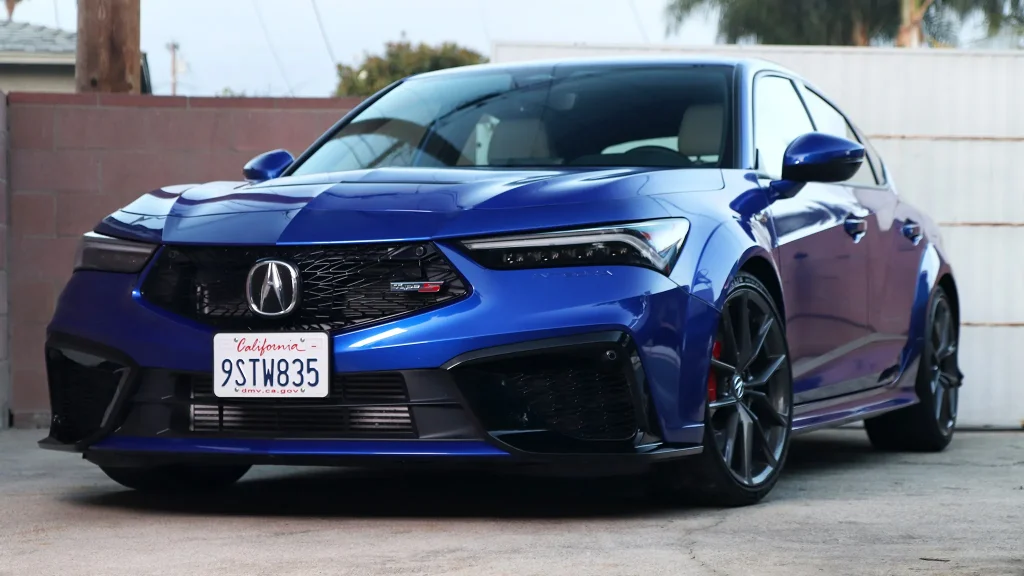
At first glance, horsepower is not the most dramatic difference. Architecture is.
The RSX Type S was a two-door 2+2 hatchback, compact and coupe-like in its proportions—closer in spirit to something like a modern Honda Prelude. The current Integra Type S, by contrast, is a four-door hatchback with four-passenger intent, reshaping the formula into something far more adult and daily usable. What was once a youthful, tight coupe has evolved into a performance sedan that refuses to abandon practicality.
The dimensions underline that transformation clearly. At 186.0 inches long, 74.8 inches wide, and 55.4 inches tall, the Integra Type S is 13.6 inches longer and 6.9 inches wider than the RSX Type S, while remaining only marginally taller. Its wheelbase stretches to 107.7 inches—up 6.5 inches from the RSX—and curb weight rises from 2,840 to 3,199 pounds. Even so, weight distribution barely shifts, moving from 63 percent front in the RSX to 62 percent in the Integra.
Inside, the expansion is most obvious in the rear cabin. Front headroom grows modestly, but rear headroom and especially rear legroom see dramatic gains—from 29.2 inches in the RSX to 37.4 inches in the Integra. The old car offered back seats in name and emergency use; the new one can genuinely accommodate adults without apology.
Styling follows the same evolutionary arc. The RSX Type S was subtle, even understated in its performance signaling. Its coupe silhouette and restrained badging hinted at capability without insisting on it.
The modern Integra Type S takes the opposite approach. It distinguishes itself within the lineup through a wider stance, larger wheels, functional cooling vents, a rear diffuser, and a triple-exit exhaust that leaves little ambiguity about intent. It remains more restrained than a Honda Civic Type R, but compared with the RSX, its performance message is far more explicit before the engine even starts.
Powertrain: Same Formula, Different World
Underneath, the philosophical link remains clear: front-wheel drive, a 2.0-liter inline-four, and a six-speed manual gearbox. But the execution has moved into a different era entirely.
The RSX Type S used the naturally aspirated K20Z1, an evolution of the earlier K20A2. It revved eagerly to over 8,000 rpm and produced around 210 horsepower and 143 lb-ft of torque. Its character was built on urgency, timing, and a willingness to chase redline repeatedly to extract performance.
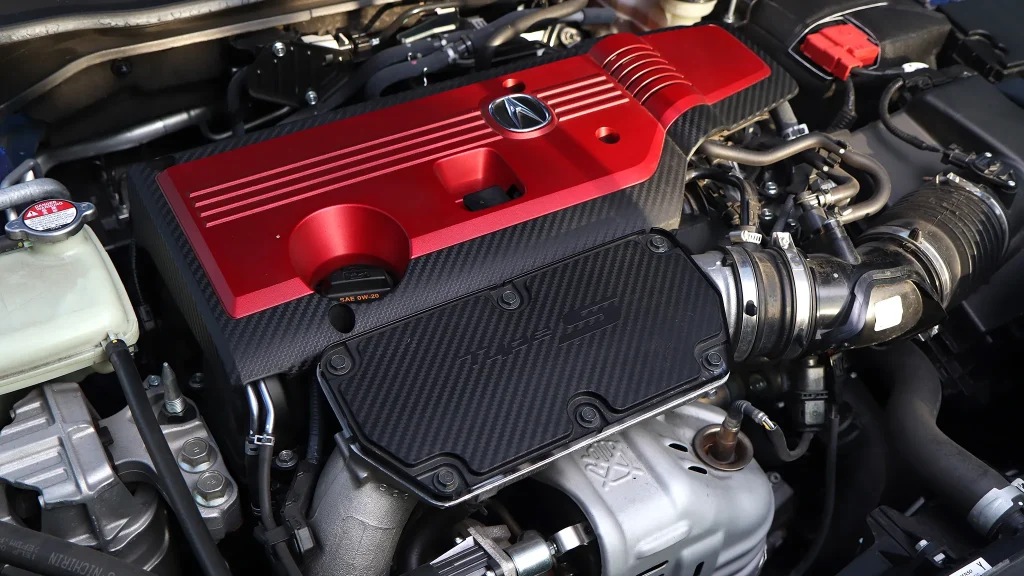
The modern Integra Type S uses the turbocharged K20C8, closely related to the engine in the Honda Civic Type R. Redline drops to around 7,000 rpm, but output rises dramatically to 320 horsepower and 310 lb-ft of torque. The result is not just more power, but a fundamentally different delivery—one defined by midrange force rather than high-rpm theatrics.
The performance gap reflects that shift clearly. An early RSX Type S reached 60 mph in 6.7 seconds and ran the quarter mile in 15.1 seconds. Our long-term Integra Type S cuts that to 5.5 seconds and 14.2 seconds respectively. Where the RSX demanded revs and momentum, the modern car delivers immediate thrust—and with it, the new challenge of managing traction under heavy torque.
Fuel economy, somewhat surprisingly, remains in the same general range, with only minor improvements despite the massive increase in performance.
Handling: Same Mission, New Hardware
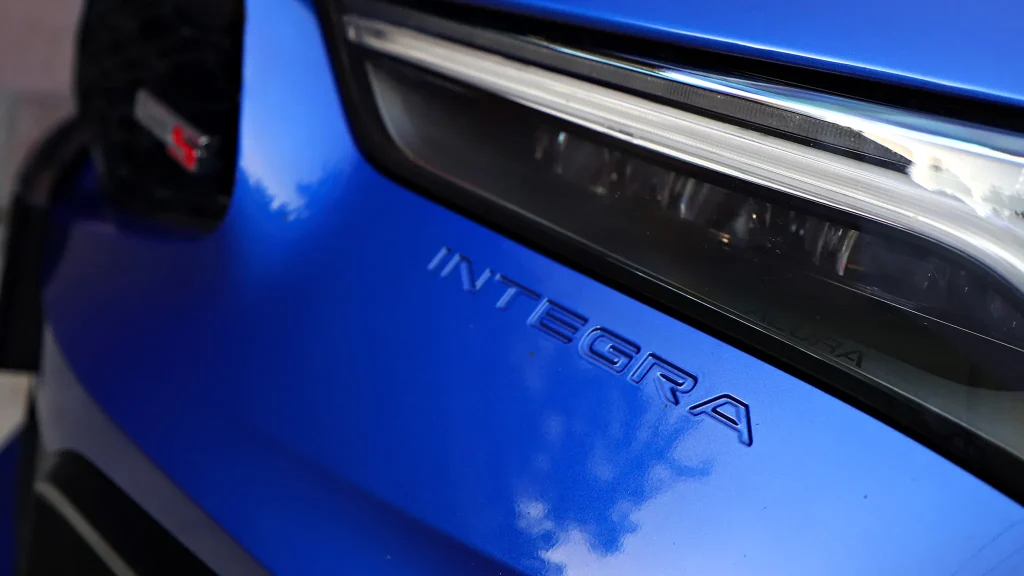
The RSX Type S embodied the lighter, simpler engineering ethos of its era. A straightforward MacPherson strut front setup paired with a double-wishbone rear suspension gave it a responsive, communicative character that matched its modest power output. Its hardware—stabilizer bars, compact wheels, and relatively narrow tires—kept the focus on balance rather than outright grip.
The Integra Type S takes a far more sophisticated approach. A dual-axis strut front suspension is specifically designed to manage torque steer and high-output front-drive behavior. A multilink rear setup replaces the simpler architecture, while adaptive dampers, a limited-slip differential, and Brembo brakes bring modern control and stopping power into the equation. Tire and wheel sizes have expanded dramatically as well, with wide 265-section summer rubber on 19-inch wheels signaling just how far expectations have moved.
The results are equally telling. Lateral grip rises from 0.82 g in the RSX to 0.98 g in the Integra Type S. Braking distances shrink from 134 feet to 105 feet from 60 mph. The older car’s strengths lay in lightness and feedback; the new one delivers outright grip, stability, and braking authority that the RSX simply cannot replicate.
Evolution, Not Imitation
The RSX Type S doesn’t look diminished so much as it looks anchored in its time. It represents a period when lightweight construction, high-revving engines, and mechanical purity defined the compact performance experience. Its appeal was immediacy and involvement, not outright numbers.
The Integra Type S, by contrast, reflects the modern reality of performance engineering: heavier, more complex, and far more capable. It uses forced induction, advanced chassis systems, and significantly larger hardware to deliver a level of speed and control the RSX era never approached.
What ties them together is intent rather than execution. Both are front-drive Acura sport compacts powered by K-series engines and paired with manual transmissions. But where the RSX Type S was about extracting every last rev from a naturally aspirated engine, the Integra Type S is about harnessing abundant turbocharged torque and translating it into controlled speed.
The RSX remains a charming artifact of a different performance philosophy. The Integra Type S is the same idea—re-engineered for an entirely different performance world.
2025 Acura Integra Type S | |
SERVICE LIFE | 12 months/14,235 miles |
BASE/AS-TESTED PRICE | $54,095/$54,695 |
OPTIONS | Apex Blue Pearl paint, $600 |
EPA CITY/HWY/COMB FUEL ECON; COMB RANGE | 21/28/24 mpg; 298 miles |
AVERAGE FUEL ECON | 23.9 mpg |
ENERGY COST PER MILE | $0.21 |
MAINTENANCE AND WEAR | $0: Car inspected by dealer and Honda for emissions-system and auto rev-match fault codes, rattling rear cargo cover (warranty) |
DAMAGES | None |
DAYS OUT OF SERVICE/WITHOUT LOANER | 7 |
DELIGHTS | Excellent handling, strong acceleration, hatchback practicality |
ANNOYANCES | Road noise, parallel parking |
RECALLS | None |