

The 2026 Sportage Hybrid is now coming off the production line at Hyundai Motor Group’s Metaplant America—marking the first Kia model ever built there. It also becomes the first hybrid vehicle assembled at the new Georgia facility, which only began producing electric vehicles in early 2025 and is already being viewed as a turning point for the Hyundai, Kia, and Genesis brands.
The Metaplant also builds the Hyundai Ioniq 5 and Ioniq 9 electric models. It was engineered with the flexibility to handle up to 10 different vehicles across all three brands. That future lineup could even stretch into body-on-frame vehicles, extended-range hybrid systems, and, according to long-term projections, potentially humanoid robotics.
Until now, the Sportage Hybrid was exclusively produced in South Korea. Shifting part of that output to the U.S. helps sidestep import tariffs while also addressing a persistent shortage of hybrid supply. Inventory had been tight last year but has since begun to recover. Through May, about 79,000 Sportages were sold in the U.S., a roughly six percent increase. However, Kia North America president and CEO Sean Yoon noted that once hybrid availability improved, sales surged by more than 100 percent in recent months. He emphasized that local hybrid production at the Metaplant arrives at exactly the right moment to push growth further.
At Kia’s nearby West Point facility in Georgia, production of the Telluride hybrid was recently added—and it is already outselling the gasoline version. That plant produces five models in total: the gas-powered Sportage and Sorento, the Telluride, as well as the electric EV6 and EV9. West Point has been in operation since 2008, after breaking ground in 2006, and now employs roughly 3,200 workers.
Across both sites, Kia now has the capacity to produce more than 550,000 vehicles annually in Georgia—about 350,000 at West Point and 200,000 at the Metaplant. Kia is expected to account for around 40 percent of Metaplant output, with plans to add one or two additional models in the future. The company’s broader goal is ambitious: to have half of its U.S. sales built domestically within two years.
Need to Make More Hybrids
The Metaplant currently employs around 2,000 workers and still has significant space for expansion. Hyundai Motor Group plans to boost capacity by another 30,000 units per year and eventually add a second on-site plant capable of producing an additional 250,000 vehicles, bringing total potential output to about 580,000 units, according to Chris Sussock, chief manufacturing officer for Hyundai North America. A second shift has already been introduced to support rising output.
Originally, the facility was conceived as an all-electric manufacturing hub centered on the Ioniq 5 and Ioniq 9. But that vision shifted mid-construction. “We realized we needed to pivot,” Sussock explained. The plant was retooled to support hybrid production alongside EVs, allowing it to respond more fluidly to changing demand. Advanced automation systems now enable rapid switching between different models.
That adaptability is becoming increasingly important. EV demand has proven less predictable than expected—surging, slowing, and rebounding in cycles. Kia’s leadership says the company intends to track those shifts rather than resist them. As Yoon described it, strategy follows the market.
Looking ahead, Kia aims to maintain a full spectrum of powertrains: internal combustion engines, hybrids, plug-in hybrids, battery electrics, and, in time, extended-range hybrids where the combustion engine functions primarily as a generator. Their arrival will depend entirely on market readiness—“when the market needs it,” as Yoon put it.
Building the Kia Sportage Hybrid
The first Kia Sportage Hybrid produced at the Metaplant rolled out just over a month ago. It is assembled on a secondary general assembly line shared with the Ioniq 9. At present, the line builds roughly four Sportage units for every one Ioniq 9.
The facility is operating at about half of its total capacity, shipping nearly 6,000 vehicles in the most recent month. It is not yet running at full intensity, leaving substantial room for expansion. Full ramp-up is expected by 2028.
Until the Metaplant can fully meet demand in the U.S. and Canada, Kia will continue importing Sportage Hybrids from South Korea—likely for another two years. Plug-in hybrid versions will continue to be sourced exclusively from Korea. Meanwhile, gasoline-only Sportage models remain in production at West Point. At present, Sportage sales are roughly split: 53 percent gasoline, 44 percent hybrid, and 3 percent plug-in hybrid.
Metaplant is Company’s New Benchmark
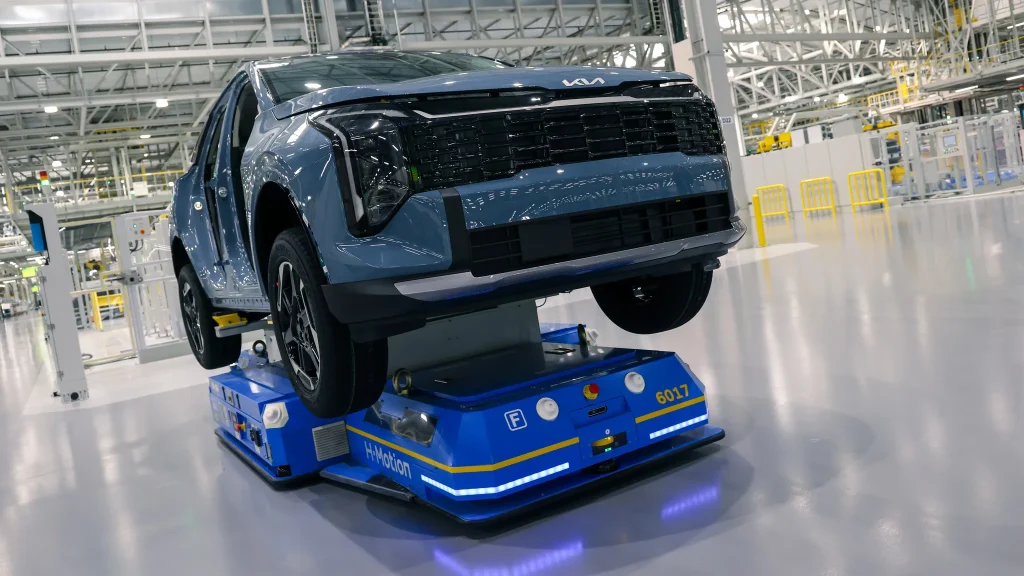
The Metaplant stands as Hyundai Motor Group’s most advanced manufacturing site and is being positioned as the blueprint for future factories worldwide, according to Yoon.
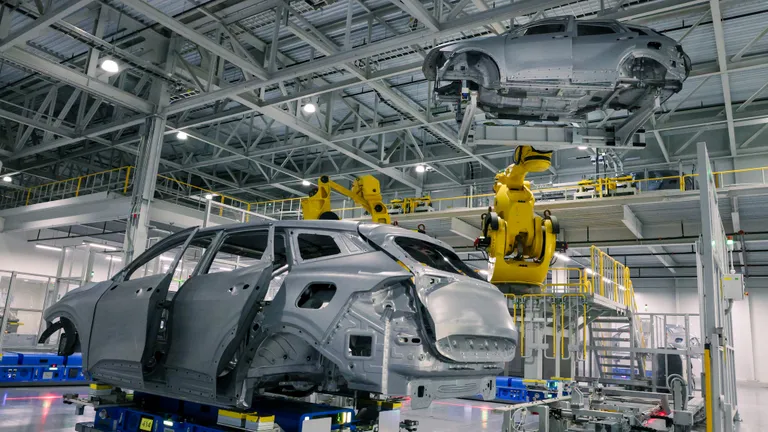
Visually, the facility is defined by sage-green structures that house a bright, spacious, and highly controlled environment. It is heavily automated, with robots and AI systems handling much of the physical workload, while human employees are concentrated in final assembly and precision-focused roles.
The production process begins with massive rolls of steel arriving at the on-site Hyundai Steel facility. These are flattened into blanks and then stamped into components using enormous dies lifted by cranes. One stamping machine alone can press up to 15 panels per minute. Finished parts are stored, then transported roughly two days later to welding operations. The site already has stamping capacity prepared for future expansion.
Automation dominates nearly every stage. Each of the two weld lines in the body shop is supported by around 500 robots—far exceeding the total number used across the entire West Point facility. Automated Guided Vehicles (AGVs) move continuously through the plant, attaching to production lines, delivering components, and swapping out as they empty and refill. Completed vehicle bodies glide on robotic carriers through a light tunnel, where workers inspect surfaces by hand for imperfections before sanding them ahead of painting.
In the paint shop, vehicles spend six to eight hours undergoing coating, using roughly a gallon of paint per unit. Elsewhere, robotic dogs patrol the lines, scanning QR codes with sensors to verify trim specifications before vehicles proceed to general assembly. Robots also handle the removal and reinstallation of doors—an operation Kia says is unique to this facility. Many physically demanding tasks, such as seat and tire installation, are also automated, reducing strain-related risks for workers. Employees instead focus on precision work like wiring installation, often working with vehicles raised on adjustable lifts. Even the flooring is made of wood to reduce stress on joints.
Battery Plant Now in Operation
Battery packs are delivered from the on-site joint venture with LG and arrive on the second floor, where they are integrated with Sportage Hybrid bodies in the final assembly stage. The battery facility itself has only recently begun operations, just within the past few weeks. A nearby parts building maintains roughly one hour of supply at any given time to keep production flowing smoothly.
Once assembled, parking robots transport finished vehicles to the quality control area, guided by QR codes to minimize human movement and improve efficiency. After inspection, every vehicle still receives a final human check, including a test drive to detect any rattles or unusual noises.
All completed vehicles are destined for customers in the United States and Canada. Shipments traveling under 500 miles are moved by truck, while longer distances are handled by rail. A large parking area covered with 1,700 solar panels both shelters finished vehicles and generates electricity for the facility.
The broader complex also includes a medical center, an on-site fire truck, and an exhibition hall that will eventually open to the public, showcasing the technology behind modern vehicle production. Planned additions include a large eco-park with greenery, water features, and walking trails for employees. A substantial water tower has also been built to support both the plant and anticipated future development in the surrounding area.
Top 10 Concept Cars Unveiled This Year