

During this weekend’s 24 Hours of Le Mans, as endurance racing thunder rolls down the Mulsanne Straight, BMW is using the global stage to unveil its newest design study: the M Concept Neue Klasse. Officially, it is described as a preview of the future design language for the BMW M division. Unofficially, it strongly hints at an upcoming high-performance, all-electric evolution of the next-generation i3. Either way, it signals a future direction for BMW M that is both bold and likely to spark debate.
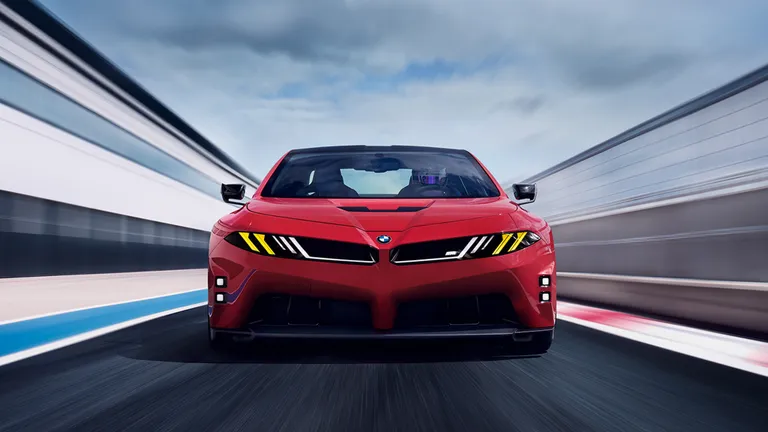
One of the first visual signatures to stand out is the Monza Red exterior, punctuated by striking yellow forward-facing lighting embedded within the kidney grille structure. This lighting language is drawn directly from BMW’s GT racing machines and the BMW M Hybrid V8, which uses similar illumination during night stints. It is expected to become a defining visual marker separating future M performance models from standard BMW road cars.
A Front End Inspired by the Sea
BMW M designers have also pulled inspiration from an unexpected source: high-performance sailing. The front bumper’s three-part structure, shaped with a shark-nose profile, borrows cues from trimarans and other fast multihull vessels. Functionally, it supports the front splitter while channeling airflow with precision.
Flanking this structure are “Track Lights,” a new three-dimensional lighting element that will likely feature across future M models. Air passing through the front openings is directed upward via a V-shaped hood vent, acting as a functional heat outlet. Even in an electric performance application, cooling remains essential under sustained high-load driving conditions.
Quad-Motor Performance Architecture
Underneath the concept lies its most significant technical statement: a quad-motor BMW M eDrive system based on BMW’s next-generation Gen6 architecture. Each wheel is independently driven, coordinated by BMW M Dynamic Performance Control, which manages torque delivery and even individual brake calipers. The aim is surgical precision through corners and an unprecedented level of control in high-performance driving.
Power is supplied via an 800-volt electrical system paired with an estimated 100 kWh battery pack. The battery is structurally integrated into the chassis, reinforcing rigidity while enhancing handling stability — a key advantage for track-focused electric performance machines.
The concept rides on center-lock wheels pushed outward into aggressively flared arches. While BMW does not explicitly confirm it, the wheel design appears to reference the iconic E30 M3 basket-weave motif. The red and blue detailing on the wheel locks reinforces the brand’s motorsport heritage.
Aerodynamic mirror units — inspired by racing prototypes — also feature, with BMW M tricolor accents integrated into their edges. These components are designed to reduce drag while maintaining functional visibility.
Materials, Weight Strategy, and Design Experimentation
In pursuit of efficiency, BMW M replaces traditional carbon fiber in select areas with natural fiber composites, used for components such as the roof, splitter, hood vent, and rear diffuser. This shift reflects an ongoing exploration of sustainable performance materials without compromising rigidity.
From above, the roofline highlights this philosophy, incorporating lightweight construction while maintaining structural purpose and visual identity through subtle M tricolor detailing.
A “Floating” Rear Design
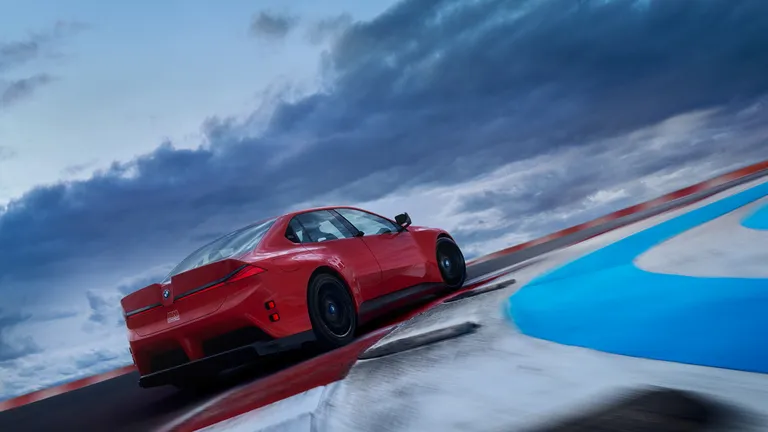
The rear design pushes conceptual boundaries further. The decklid flows into a ducktail spoiler integrated into widened rear haunches, but with a split section that frames the central BMW roundel. Below, the bumper adopts a layered aerodynamic structure, again inspired by trimaran geometry, creating the impression that the rear diffuser is visually “suspended.”
Three-dimensional “Track Lights” return at the rear, this time with red illumination, reinforcing the concept’s race-inspired lighting language.
A Driver-Focused Interior for the Electric M Era
Inside, the cabin reflects a deliberate focus on the driver, blending racing intent with next-generation digital interfaces. Four bucket seats support high-performance driving demands, constructed using natural composite materials instead of traditional carbon fiber.
Color accents in Bathurst Blue and Berry Red Merino leather define the interior palette, while red five-point harnesses reinforce the motorsport character. The steering wheel is wrapped in nubuck leather — a softly textured material commonly associated with performance luxury — and integrates red shift paddles along with a centrally mounted control hub.
The dashboard floats visually, wrapped in fabric with ambient lighting that forms an M-specific hexagonal pattern. Digital interfaces, likely derived from BMW’s Neue Klasse infotainment system, are reworked with performance-focused graphics and telemetry-inspired layouts.
A Glimpse of the Next M Generation
While the M Concept Neue Klasse carries clear conceptual exaggerations, its underlying architecture suggests a near-future production reality rather than pure fantasy. Elements such as the quad-motor drivetrain, overall proportions, and interior layout are expected to influence upcoming electric M models.
The concept effectively previews what may become a high-performance evolution of BMW’s next-generation i3, with production timing projected around 2027. Some features will inevitably be toned down, but the direction is unmistakable: BMW M is preparing to enter a fully electrified era where precision, control, and digital integration redefine performance.